


How to Measure Penis Girth: A Guide to Measuring Length and Girth
- Written
Key takeaways
- To measure penis girth, wrap a flexible tape around the thickest part of the fully erect shaft, snug but not tight, and read the number where the tape meets.
- To measure length, press a rigid ruler into the pubic bone along the top of the erect shaft and read to the tip of the glans (bone-pressed erect length).
- Measure at full erection, in a warm room, on several different days, and average the results.
- A 2015 BJU International review found an average erect length of 5.17 inches (13.12 cm) and an average erect girth of 4.59 inches (11.66 cm).
To measure penis girth, wrap a flexible tape around the thickest part of your fully erect shaft, snug against the skin but not tight, and read the number where the tape meets itself. To measure length, press a rigid ruler into the pubic bone and measure along the top of the shaft to the tip of the glans. The steps below cover both, plus the mistakes that throw readings off.
Introduction: Why Accurate Measurement is the First Step to Improvement
The proper way to measure penis length uses the same method every time, so your results stay comparable from one day to the next. Whether you're selecting the right condom size, tracking natural improvement progress, or simply understanding your anatomy, a consistent measurement is essential.
Quick Answer - Proper Penis Measurement Method:
- Length: Use a rigid ruler, press firmly into pubic bone, measure along top to glans tip
- Girth: Wrap flexible tape around thickest part of shaft, snug but not tight; if you are working on girth, see penis clamping
- State: Always measure when fully erect for consistency
- Position: Stand upright during measurement
Most men make avoidable errors when measuring - like measuring from the side, not pressing to the pubic bone, or using partial erections. These mistakes shift your numbers enough that real changes are hard to spot, and your readings no longer line up with published studies.
This guide uses bone-pressed erect length (BPEL) because it takes the pubic fat pad out of the equation. A 2018 International Journal of Impotence Research study of 201 men found that pubic bone-to-tip length was more accurate and reliable than skin-to-tip length, with the biggest gap in overweight men.
Accurate measurement isn't just about numbers - it's about establishing a reliable foundation for improvement and supporting an approach to natural improvement designed with comfort and safety in mind.
I'm John Hanger, President at Zen Hanger, and I've spent years helping men understand the proper way to measure penis length as the critical first step in their natural improvement journey. My experience has shown that accurate baseline measurements are essential for both safety and tracking meaningful progress with thoughtfully designed devices.
How to Measure Your Penis: Length and Girth Step by Step
Use the same approach clinicians use when they measure: the same position, the same landmarks and the same erection state every time. That consistency matters for selecting a properly fitted condom, comparing your numbers with published averages, or sizing a device.
Step 1: How to Measure Penis Length (Bone-Pressed Erect Length)
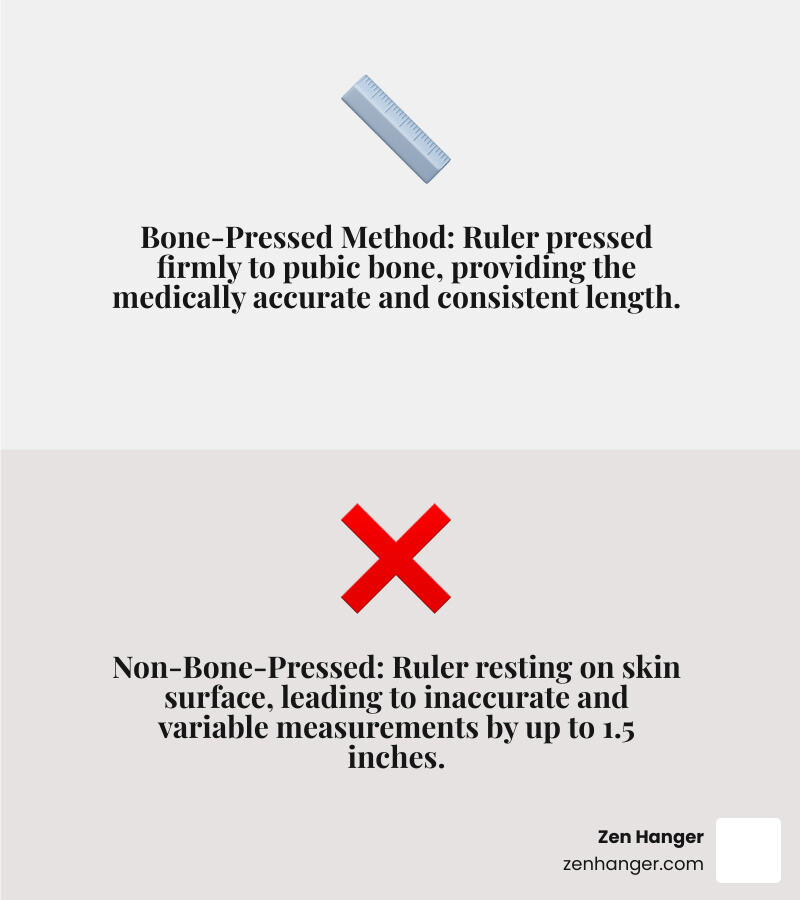
The medical standard for measuring penis length is Bone-Pressed Erect Length (BPEL). This method is crucial because it eliminates the variable of the pubic fat pad, which can hide a significant portion of your functional length.
To begin, achieve a full erection, as a partial erection can significantly underestimate your true size. Stand upright for consistent results and use a rigid ruler (plastic or metal is ideal). Flexible tapes are not suitable for length measurement as they can bend and distort the reading.
The "bone-pressed" technique is key. Place the ruler on the top side (dorsal surface) of your penis at the base. Press it firmly into your pubic area until it makes solid contact with the pubic bone. This provides a fixed, unchanging reference point, which is especially important for men with a higher BMI.
With the ruler held firmly against the bone, measure in a straight line to the tip of the glans (the head). If you are uncircumcised, do not include the foreskin. Gently straighten any natural curve to measure the longest possible line.
To establish a reliable baseline, take multiple measurements over several days and average the results. Avoid common mistakes that can noticeably change your readings, such as measuring from the side, not pressing to the bone, or measuring a partial erection.
A 2018 study of 201 men, each measured by seven specialists, found that pubic bone-to-tip length was more accurate and reliable than skin-to-tip length, and that the gap was largest in overweight men. For those considering natural improvement, this baseline is the foundation for tracking progress safely. Learn more in our guide on how penis length measurement works.
Step 2: How to Measure Penis Girth (Circumference)
While length gets more attention, girth is the other half of your baseline and it matters for condom fit. If you want to dig into the topic, our guide to methods men try to increase girth is a good next read.
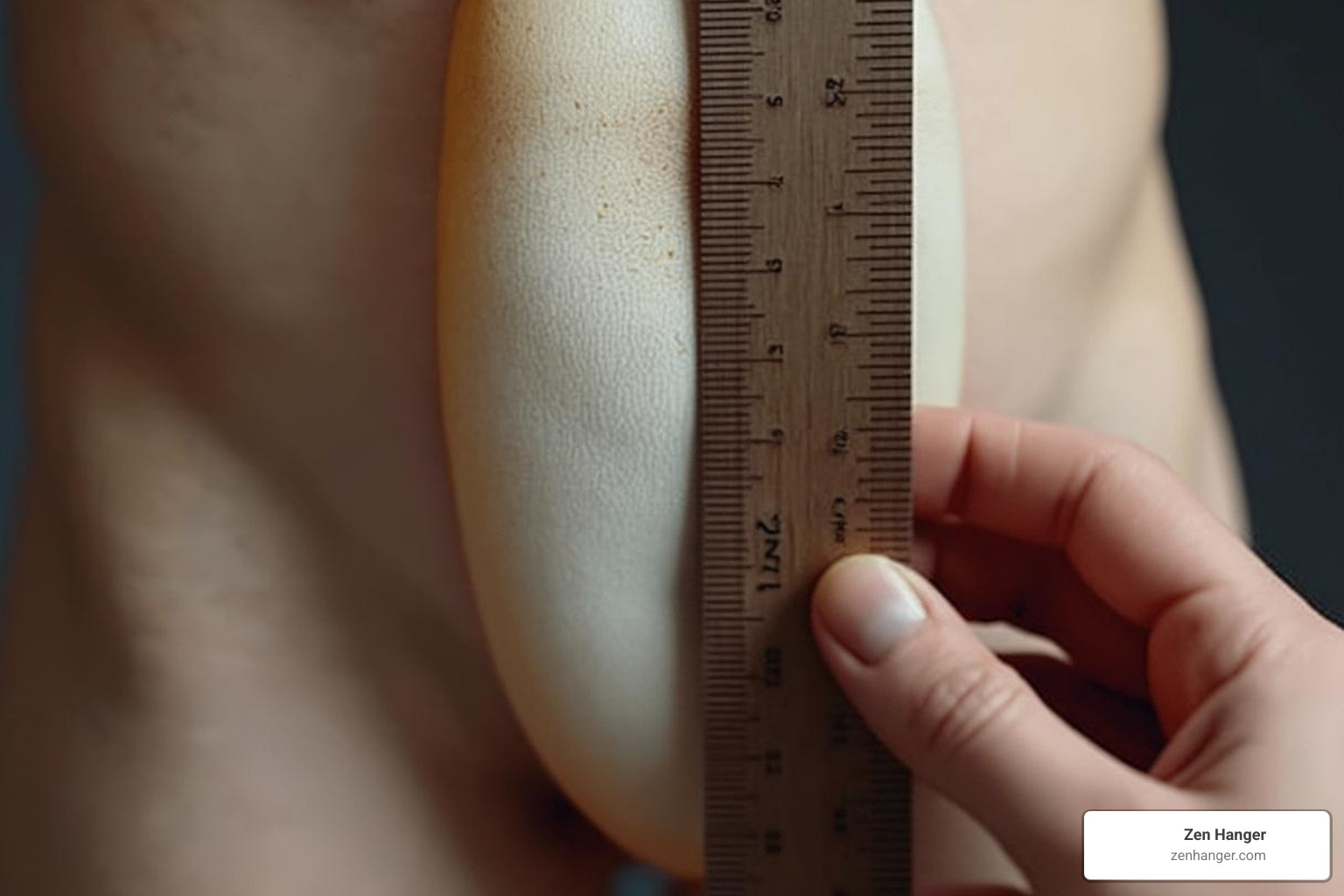
For this measurement, you will need a flexible tailor's measuring tape. If you don't have one, a non-stretchable string and a ruler will also work: wrap the string, mark where it overlaps, then lay it flat against the ruler.
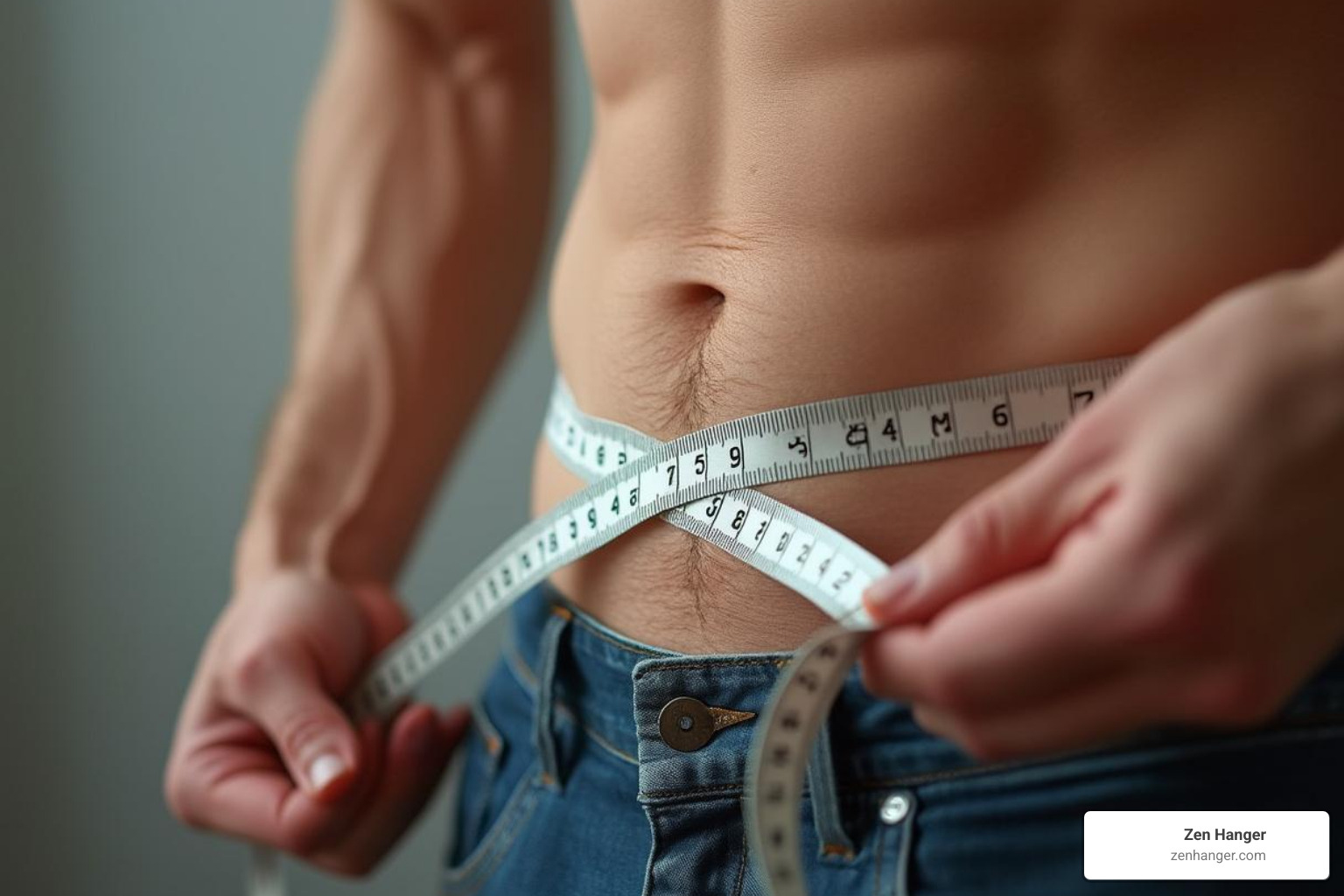
Begin with a full erection. Find the thickest part of your shaft, which is typically mid-shaft but can vary. Wrap the tape snugly around this point—it should make full contact with the skin without compressing it. The fit should be snug but comfortable. Read the number where the tape meets itself. If your tape is in centimeters, divide by 2.54 to get inches.
Avoid common mistakes like pulling the tape too tight, which gives an artificially small reading, or using a rigid ruler. Do not measure at the narrower base or the head.
Accurate girth is useful when considering natural improvement with thoughtfully designed devices like penis hangers or extenders, as proper sizing supports both comfort and safety. For girth work, the Zen Clamp kit is made for the purpose.
As with length, take several measurements over different days and average them for a reliable baseline. For more on tracking progress, see our guide on how to measure penis gains.
Special Considerations: Curved Penises and Measurement Consistency
Some curvature is common and requires only minor adjustments for accurate readings. For length, the bone-pressed method still applies. For consistency, we recommend the most direct bone-to-tip measurement, gently straightening the penis. For sharp or painful curvature, talk to a healthcare professional. Girth measurement is straightforward with a flexible tape.
Your measurements naturally fluctuate due to factors including:
- Temperature: Avoid measuring in cold rooms.
- Physiological State: Stress, fatigue, and hydration levels can alter size.
- Time of Day: Blood flow patterns can cause slight variations.
Weight changes don't change the length of the penis itself, but fat loss can make more of it visible: a 2018 review in Translational Andrology and Urology notes that weight loss may increase the size of the visible penis by decreasing the surrounding fat. That is another reason to use the bone-pressed method when tracking. Our guide on whether losing weight makes your penis bigger explains the fat pad in more detail.
Establishing a reliable baseline is essential. Average multiple measurements taken over several days under similar conditions. This baseline is your foundation for tracking progress with non-surgical methods and ensures proper device sizing and safety with products like those from Zen Hanger.
Understanding Your Measurements and Next Steps
Once you've carefully taken your measurements, you might wonder, "What do these actually mean?" Here is how they compare with published averages.
What Do the Numbers Mean? Average Size and Why It Matters
Societal myths and media portrayals often create unrealistic expectations and anxiety about penis size. Published research gives a clearer picture of what is average.
A 2015 systematic review in BJU International pooled data from up to 15,521 men, with measurements taken by health professionals rather than self-reported:
| Measurement Type | Average (Inches) | Average (Centimeters) | Notes |
|---|---|---|---|
| Flaccid Penis Length | 3.6 | 9.16 | |
| Flaccid Stretched Penis Length | 5.21 | 13.24 | Often used to estimate erect length in clinics. In a 2018 study of 201 men, stretched flaccid measurements underestimated erect size by about 20%. |
| Erect Penis Length | 5.17 | 13.12 | The average erect length across the studies pooled in the review. |
| Flaccid Penis Girth | 3.67 | 9.31 | |
| Erect Penis Girth | 4.59 | 11.66 | The average erect girth. |

Source: A 2015 systematic review on penis size
If your measurements are near these averages, you are in the typical range. Averages are not targets, and a number on a tape is only one part of how men feel about their bodies.
Measuring is also practical for choosing a condom size that fits.
The Importance of the Proper Way to Measure Penis Length for Improvement
The proper way to measure penis length matters if you're considering natural improvement methods. This desire is often deeply personal, driven by goals for confidence, body image, or exploring one's potential.
- Establish a True Starting Point: A precise baseline measurement provides the objective data needed to track real changes and distinguish actual progress from wishful thinking.
- Track Progress Objectively: Consistent measurement gives you something concrete to review, which helps you stay consistent with your routine.
- Support Device Sizing and Comfort: Device sizing and comfort rely on accurate measurements. Penis hangers and extenders apply consistent tension that you can adjust. Your length and girth help you select and use the right device for your anatomy.
Our devices apply steady, adjustable tension and are a non-surgical option compared with invasive procedures. The research on traction devices is limited: Mayo Clinic notes that a few small studies have been done and says more research is needed to see whether stretching is safe and whether it works.
Setting realistic expectations is key. Progress, if any, is slow, so a consistent log matters more than any single reading. For detailed guidance, explore our guide on More info about measuring penis gains.
Conclusion: Taking Control of Your Improvement Journey
Understanding the proper way to measure penis length and girth gives you a dependable baseline. It is the foundation for selecting condoms, putting size concerns in context, or beginning a natural improvement routine.
At Zen Hanger, we focus on education and on devices designed with comfort and safety in mind. We make non-surgical options built for steady, adjustable wear, which is what the All Day Stretcher is made for.
Your routine begins with a precise measurement. Accurate data lets you set realistic goals and review your own log honestly. We are here to support you with the tools and guidance you need. For next steps, read how to get a girthier penis or learn how clamping for girth works.
For the most comprehensive guidance on mastering every detail of accurate measurement, refer to our complete A step-by-step penis measurement guide.
How to track your progress
Keep a short log: the date, time of day, room temperature, which method you used, and your reading. Measure the same way each time and compare weekly averages instead of single readings. Take a quick photo of your ruler or tape placement so you can repeat it exactly.
Get the most from every session
If you add a device to your routine, start with short sessions and build duration gradually. Remove the device right away if you notice pain, numbness, color change or swelling. In the studies a 2021 European Society for Sexual Medicine statement covered, side effects of traction devices were described as mild and well tolerated, including discomfort and occasional numbness of the glans. Follow the product instructions, and talk to your doctor before you start if you have a medical condition or questions.

Start here
Zen Hanger Complete Kit
$399
+ $74.98 in free extras
Every tool in one case, so you don't have to guess which device fits.
Plain box · Statement shows ZH LLC · 60-day money-back guarantee
Frequently Asked Questions
How do you measure penis girth?
Wrap a flexible tape around the thickest part of your fully erect shaft, snug against the skin without squeezing, and read the number where the tape meets itself. No tape? Wrap non-stretch string, mark the overlap, and lay it flat against a ruler. Repeat on a few days and average.
How do you measure penis length correctly?
Stand up with a full erection, press a rigid ruler into the pubic area until it meets the pubic bone, and measure along the top of the shaft to the tip of the glans. Leave out any foreskin. Take several readings on different days and average them for your baseline.
What is the difference between bone-pressed and non-bone-pressed measurement?
Bone-pressed length presses the ruler into the pubic fat pad until it touches the pubic bone. Non-bone-pressed length rests the ruler on the skin, so the fat pad hides part of the shaft. A 2018 study of 201 men found bone-to-tip length more accurate and reliable than skin-to-tip length.
What is the average penis girth?
A 2015 BJU International systematic review of up to 15,521 men found an average erect girth of 4.59 inches (11.66 cm) and an average flaccid girth of 3.67 inches (9.31 cm). Averages are not targets. Your own consistent baseline is more useful for tracking.
How often should you measure?
Measure on several different days under similar conditions, such as the same time of day in a warm room, and average the results to set your baseline. After that, check on a regular schedule such as weekly, because everyday fluctuations can hide or exaggerate real changes.
Related Guides
- How to track penis measurements
- How to measure penis size: step-by-step
- What is the average penis size?
- Does losing weight increase penis size?
References
- Veale D, Miles S, Bramley S, Muir G, Hodsoll J. Am I normal? A systematic review and construction of nomograms for flaccid and erect penis length and circumference in up to 15,521 men. BJU International, 2015;115(6):978-986. pubmed.ncbi.nlm.nih.gov
- Habous M, Muir G, Soliman T, et al. Outcomes of variation in technique and variation in accuracy of measurement in penile length measurement. International Journal of Impotence Research, 2018;30:21-26. doi.org
- Mayo Clinic Staff. Penis-enlargement products: Do they work? Mayo Clinic, April 17, 2025. mayoclinic.org
- García-Gomez B, et al. The Use of Penile Traction Devices for Peyronie's Disease: Position Statements from the European Society for Sexual Medicine. Sexual Medicine, 2021;9(4):100387. Summary: issm.info
- Ho TS, Gelman J. Evaluation and management of adult acquired buried penis. Translational Andrology and Urology, 2018;7(4):618-627. pmc.ncbi.nlm.nih.gov
Stop reading. Start training.
Everything you need, in one box. Every tool in one case, so you don't have to guess which device fits.
- Weight hanging system
- Extender for daily wear
- Pump
- Volume & Recovery pills*
- Exercise guide
Just want weights?

- Weight hanging system
- No extender, pump or pills
- No free extras

- Weight hanging system
- No extender, pump or pills
- No free extras
*Volume & Recovery pills ship with US and Canada orders.
Questions? A real person answers.
Text, chat or email. No pressure, real answers.
(949) 438-0525 · support@zenhanger.com